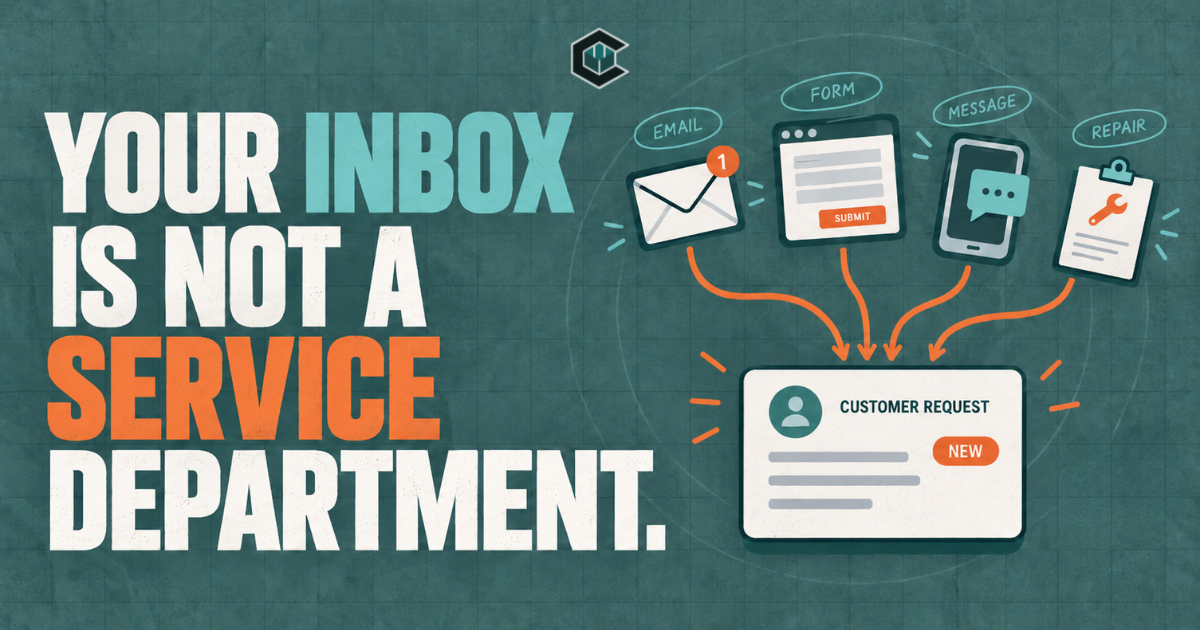
Your Inbox Is Not a Service Department
I had an experience with Best Buy that has stuck with me because it perfectly illustrates how differently a business and its customers can see the same interaction.
I had placed an order through Best Buy's website and later wanted to make a change. Conveniently, I happened to be inside a Best Buy store when I decided to make it, so I walked over to the customer service counter and explained what I needed. I figured I could not have been in a better place to solve a problem involving a Best Buy order. The person at the counter told me they could not do anything with the order because I had placed it online.
I remember looking at them and saying something along the lines of, "But I placed the order on Best Buy's website, and now I'm standing at Best Buy's customer service counter." I actually stepped away from the counter, pointed toward the giant Best Buy logo behind them and asked how the website displaying that same logo could somehow have nothing to do with the Best Buy store where I was standing.
I understood that there was probably some technical or operational reason the employee could not access what I needed. Best Buy may have had separate systems, processes, permissions, or departments behind the scenes. None of that changed what the experience felt like from my side of the counter. I had done business with Best Buy, I was standing inside Best Buy, and I wanted Best Buy to help me with my Best Buy order. Your customers see your firearms business the same way.
They do not walk into your store thinking about which system handled their online order, which inbox received their email, who monitors the website form, or whether the person standing behind the counter normally deals with repair questions. They know the name on the building, the logo on the website, and the business that took their money. Everything behind that is your business to figure out.
Your Customer Sees One Store
Inside a firearms business, communication can easily become divided into channels. Website orders may be handled by one person while another employee manages the main email address. Repair questions may go to someone behind the counter, range or membership questions may be handled somewhere else, and website forms can land in yet another inbox. Everyone inside the business understands those distinctions because they work with them every day. The customer usually does not.
Someone who ordered a firearm from your website and walks into your store with a question believes he is talking to the same business that accepted the order. A customer who emailed about a repair and calls two days later expects the person answering the phone to have some way of understanding what has already happened. If someone fills out a form about a class and later visits the range, he probably does not consider those interactions separate simply because one happened through a website and the other happened face to face.
The frustration begins when your internal divisions become the customer's problem. He explains the situation to one employee, gets transferred to another, repeats it again, learns that someone else handles that area, and eventually hears some version of, "You'll need to contact them."
From inside the business, everyone may be following the process exactly as it was designed. From the customer's perspective, he is standing underneath your logo wondering why nobody who works there seems capable of helping him.
An Inbox Is Good at Receiving Messages
Email makes this problem particularly easy to miss because it gives the appearance that everything is organized. Messages arrive with names, subject lines, dates, and times. They can be searched, forwarded, flagged, placed into folders, marked unread, and shared with other employees. These tools are useful for managing email, but customer service involves managing what the customer asked the business to do.
Imagine someone emails Monday morning asking for an update on a firearm he dropped off for repair. An employee sees the message while helping somebody at the counter and intends to come back to it. Another employee notices it later and assumes the first person already handled it. The next day gets busy, the message moves farther down the inbox, and on Wednesday the customer emails again asking whether anyone received his original message.
Nobody had to be lazy or careless for that to happen. Two employees could have read the email, both could have fully intended for the customer to receive an answer, and the business could still leave him waiting because reading a request and taking responsibility for it are two different things.
The inbox worked exactly as expected. It received the message and made it available to the people who needed to see it. What the business was missing was a dependable way to carry the request from arrival through resolution.
More People Seeing Something Does Not Create Ownership
Shared inboxes can make the situation even more deceptive. Giving several employees access to a sales, support, or general information address seems like it should reduce the chances of something being missed because more people can see what comes in. It may also create situations where several people see the same request and each reasonably assumes that someone else is handling it.
An online customer asking why his order has not shipped may involve someone who understands the order, another person responsible for fulfillment, and someone else who normally answers customer emails. By the end of the day, three employees may have seen the request without anyone clearly owning the responsibility for getting the customer an answer.
Small stores can experience the same problem without a shared inbox. An employee reads an email, walks across the room to ask someone about it, gets part of the answer, and then returns to the counter because a customer walked in. A few hours later, one person believes the other is taking care of it while the other assumes the original employee already did. The customer knows none of this. He only knows that he asked the business a question and is still waiting.
The Message and the Request Are Two Different Things
This is where I think businesses can benefit from separating the communication from the work created by that communication.
A customer may send a five-line email about a problem with an online order, but resolving that request could require someone to check inventory, look at the order history, speak with fulfillment, contact a distributor, and then get back to the customer. The email took less than a minute to read while the work created by it may continue for several days.
Repair questions can follow the same path. A customer asking for an update may require somebody to locate the firearm, find out what has been done, speak to the person working on it, determine whether a part has arrived, and communicate the answer. Treating the original email as the thing being managed makes it easy to lose sight of everything that has to happen after it arrives.
Once you start viewing these interactions as requests rather than messages, the way you think about them changes. The email, form, chat, phone call, or face-to-face conversation simply tells the business that someone needs something. From there, the business needs to know what is happening with that request until there is nothing left to do.
Nobody Wants to Start Over Every Time
The Best Buy experience bothered me because I had already established a relationship with the company through the online order. When I walked into the store, I expected that relationship to continue. Instead, I discovered a wall between two parts of the same company that I had never considered separate.
A firearms retailer can unintentionally create the same experience on a much smaller scale. A customer may talk with one employee about a transfer, email additional information later, and then come into the store when the firearm arrives. If the person at the counter has no idea about the previous conversation, the customer begins reconstructing everything the business has already been told.
That can happen with repairs, special orders, classes, memberships, online purchases, range questions, and almost any other service the business offers. Every time the customer changes channels or encounters another employee, the conversation risks starting over.
Continuity changes that experience. When the next employee can see enough of what has already happened to continue helping, the business feels like one business regardless of who happens to be standing behind the counter that day.
For a local firearms retailer, that should be an achievable standard. You may never have the size or resources of a national chain, but you also should not need them to remember your customers better than a national chain does.
Internal Requests Disappear the Same Way
The same problem happens behind the counter even when no customer is directly involved. Someone asks another employee to check a vendor issue, update something on the website, change a price, order a part, investigate an inventory problem, or handle something later in the week.
When the request can be completed immediately, a quick conversation may be all the process you need. The trouble begins when "I'll take care of it" becomes the only record that the work exists. Both employees return to whatever they were doing, a few days pass, and eventually someone realizes the task never happened.
The situation becomes even harder to untangle when several people are involved because everyone remembers the conversation slightly differently. One person thought he was waiting for information, another thought the task had already been completed, and someone else had no idea he was supposed to be involved.
These internal failures eventually become customer-service failures when they affect inventory, orders, repairs, website information, pricing, or anything else the customer depends on.
Find Out How Much Your Business Is Remembering
A retailer can learn a lot by watching requests for one week and paying attention to what happens after they arrive. Look at the customer questions, order problems, repair inquiries, special-order requests, transfer issues, website submissions, and internal tasks that require more than an immediate answer, then see whether you can determine who is responsible for each one and whether anything still needs to happen.
You may find that most are handled quickly while others bounce between employees, live in an inbox for several days, or depend on someone remembering a conversation from earlier in the week. Pay particular attention to the requests where the only way to determine their status is to ask around the store until you find somebody who remembers what happened.
At that point, ask yourself whether you could produce a reliable list of everything your business still owes someone right now. That could include an answer, callback, repair update, quote, internal task, or anything else someone is expecting from you. If producing that list requires searching through inboxes, checking text messages, asking employees, and relying on memory, the business may have more open work than anyone realizes.
That does not necessarily mean your people are failing. They may be working incredibly hard. The problem is that hard work cannot consistently overcome information scattered across too many places.
Your Customers Should Never Have to Understand Your Organization
I still do not know exactly why that Best Buy employee could not help me with my online order, and from the customer's perspective, I should not have needed to know. Their organizational structure, software limitations, employee permissions, and internal processes belonged to Best Buy. My concern was much simpler: I bought something from Best Buy and needed Best Buy to help me with it.
Your customer thinks the same way when he deals with your store. He should not have to know which employee handles website orders, who monitors a particular inbox, whether the repair department uses a separate process, or where a form goes after he submits it. He sees your business name over the door, on the receipt, in his email, and on your website. Those interactions belong to the same business in his mind, and his experience with one becomes part of how he judges all the others.
Coreware gives firearms retailers a way to bring customer and internal requests into one place so the work can remain visible after the original message arrives. Email boxes can feed into the Service system, and requests involving customer questions, orders, repairs, and internal work can be managed alongside the customer information already available in Coreware. The goal is simple: your customer should experience one business even when several people, systems, and steps are involved behind the scenes. To learn how Coreware can make these interactions smoother and build trust with your customer base, visit coreware.com.